
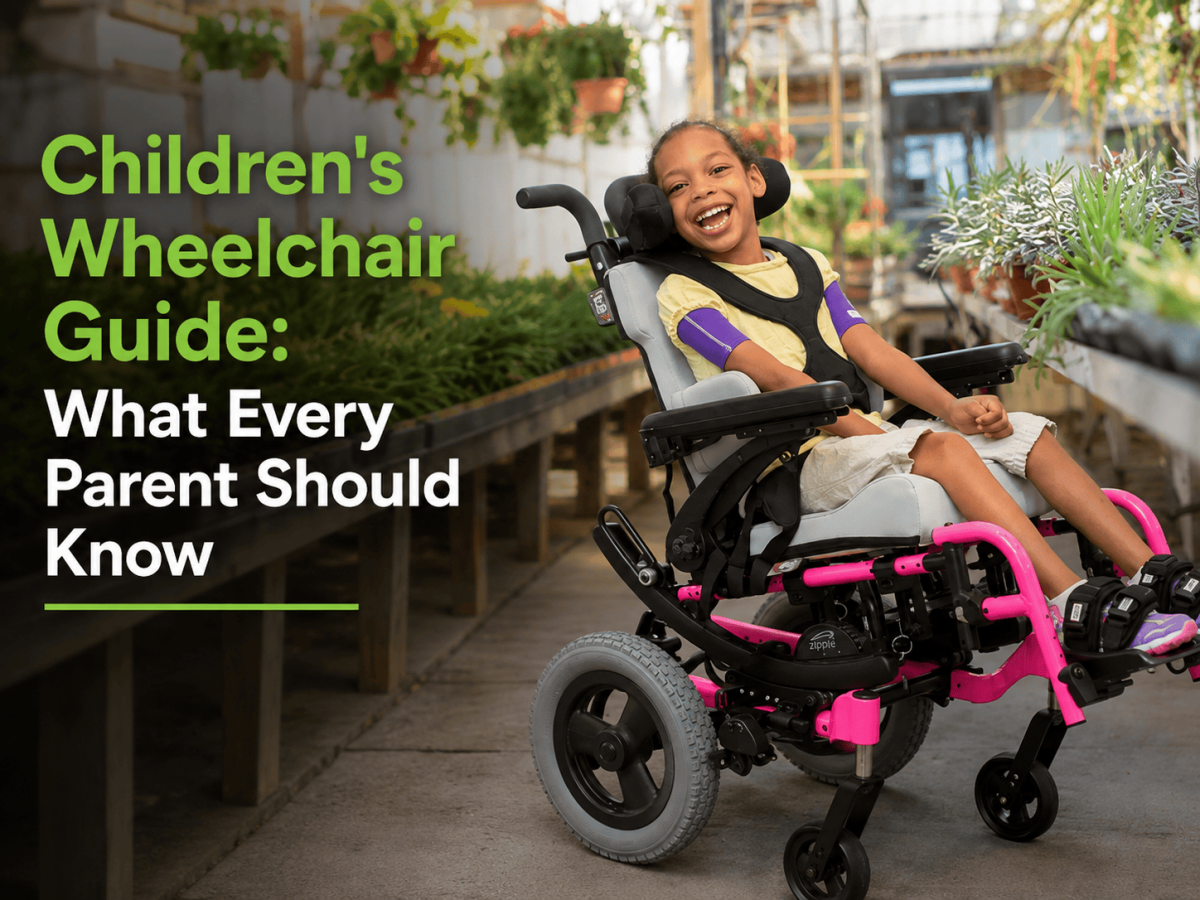
Quick Answer: A children’s wheelchair is a mobility device built and fitted specifically for a growing body, not a scaled-down adult chair. The right one depends on the child’s diagnosis, muscle strength, growth stage, and daily environment — home, school, and outdoors. Most families work with an Assistive Technology Professional to match the child to a manual or power base, then customize the seating, so the chair grows with the child for years, not months.
Most parents don’t go looking for a kid’s wheelchair. They end up there — after a diagnosis, a hospital stays, or a physical therapist quietly mentioning that walking alone isn’t going to be enough anymore. That moment is heavier than any spec sheet. A children’s wheelchair isn’t just equipment; it’s the thing that gets your child to the birthday party, the classroom, the backyard, on their own terms. Get the fit wrong and it sits in a closet. Get it right, and it becomes almost invisible — just how your kid gets around. This guide breaks down what actually matters when choosing one, from the types available to how funding works, so you’re not learning all of this the hard way.
How Pediatric Wheelchairs Support Growing Children
A children’s wheelchair is a mobility base designed around a growing, developing body — smaller frame dimensions, lighter materials, and seating that can be adjusted in stages as the child gets taller and heavier. Adult wheelchairs are built for a body that’s essentially done growing; pediatric chairs are built assuming the opposite. That distinction drives almost every other decision in this guide.
A child with cerebral palsy, spina bifida, or a neuromuscular condition like muscular dystrophy often needs postural support; an adult chair simply doesn’t offer — trunk support, hip guides, headrests, and seating angles that change as muscle tone changes. This is where a customized power wheelchair built for a child’s specific needs matters, particularly for kids who also need ventilator or oxygen support, is integrated into the base rather than bolted on as an afterthought.
What Types of Kids Wheelchairs Are Available?
There isn’t one “children’s wheelchair” — there’s a category, and picking it depends on the child’s strength, cognition, and how independently they can propel or drive. Here’s the breakdown families are usually choosing between:
| Type | Best For | Example |
| Manual, lightweight | Kids with good upper-body strength who self-propel | TiLite Aero T |
| Folding manual | Families needing easy transport in and out of vehicles | Helio A7 |
| Power wheelchair | Kids who can’t self-propel long distances or need speed/endurance | Quantum Edge 4 |
| Power with tilt-in-space | Kids needing pressure relief and postural repositioning | Permobil F5 |
| Pediatric power base | Younger children needing a smaller, growth-adaptable frame | Permobil M3 |
| All-terrain power | Active kids needing outdoor and uneven-surface mobility | Track Master S2 |
A manual wheelchair is generally lighter, cheaper, and gives the child more physical engagement — which matters for upper-body development. A power wheelchair is the better call when a child’s arms tire quickly, when distances at school are long, or when independence needs to happen now rather than after months of physical therapy. Neither option is objectively “better.” The right one depends entirely on the child sitting in it.
How Do You Know When a Child Needs a Wheelchair?
Parents often wait too long, worried that a wheelchair signals giving up on walking. It doesn’t. In most cases, mobility equipment supports development rather than replacing it — a child who conserves energy on wheels for the school day often has more energy left for therapy and play afterward. Watch for these signs:
- Your child avoids activities because walking or standing tires them out fast
- They’re falling more often, or falls are getting more severe
- A physical or occupational therapist has raised mobility as a concern
- Long distances (school hallways, grocery stores, playgrounds) leave them exhausted or in pain
- Their current mobility device no longer matches their size or needs
Here’s the thing most people miss early intervention with the right equipment that tends to support better long-term outcomes, not worse ones. Research and clinical guidance summarized in our piece on the benefits of early wheelchair intervention backs this up — delaying mobility support to “encourage walking” can sometimes cost a child more independence, not less.

What Features Actually Matter in a Children’s Wheelchair?
This is where a lot of families overspend on the wrong things and underspend on the ones that count. Seating and positioning matter more than most of the flashy features on a spec sheet, because posture affects breathing, digestion, skin health, and even how well a child can use their hands.
- Growth adjustability should be non-negotiable. A chair that can’t be resized as your child grows becomes obsolete within a year or two — an expensive mistake most families only make once. Look for adjustable seat depth, width, and back height built into the frame from day one.
- Custom seating is the second priority, especially for kids who spend most of the day seated. A properly fitted seating system — the kind detailed in our custom seating solution for skin health and independence — reduces pressure sore risk and keeps the spine aligned, which matters enormously for kids with limited trunk control.
- Portability and durability round out the list. A chair that folds easily for the car, survives a school hallway five days a week, and holds up outdoors is worth paying for over one that looks sleek but breaks down under real use.
How Much Does a Kids Wheelchair Cost, and Will Insurance Cover It?
Custom pediatric wheelchairs typically fall into the Complex Rehab Technology (CRT) category, which usually means higher cost than a standard chair — but also stronger insurance coverage, because CRT is classified as medically necessary rather than optional. Costs vary widely depending on whether the chair is manual or power, and how much custom seating is involved, but most families are not paying full price out of pocket.
That’s not a small detail — it’s the difference between waiting years and getting equipment within months. Medicaid, private insurance, and state assistance programs each have their own approval process, and navigating it alone is genuinely difficult. Our insurance options page walks through what’s typically covered and how the documentation process works, and the get started page is where most families begin the actual funding request.
Children’s Wheelchair vs. Adult Wheelchair: What’s the Real Difference?
A children’s wheelchair is a type of Complex Rehab Technology built specifically for developmental change, while an adult wheelchair assumes a stable, fully grown body. That’s the core distinction, but it plays out in a few concrete ways:
- Frame sizing: Pediatric frames adjust increments as the child grows; adult frames are fixed to one body’s size.
- Weight and materials: Kids’ chairs, like the Helio A7, prioritize being light enough for a child to self-propel or for a parent to lift into a vehicle.
- Seating depth: Pediatric seating systems account for shorter torsos and legs, with more granular adjustment than adult equivalents.
- Growth timeline: Most pediatric chairs are designed for 2–4 years of use before a resize or replacement is needed; adult chairs are built for a much longer, stable lifespan.
This works well for planning purposes, but it breaks down if a family buys an adult chair “to save money long-term.” In practice, an ill-fitting chair costs more in secondary health issues — poor posture, skin breakdown, reduced lung capacity — than the resale value it might preserve.
A Real Family’s Experience: A Custom Power Wheelchair for a Child with Respiratory Needs
It helps to see what this looks like in practice, not just in theory. One of our case studies follows a three-year-old who relied on ventilator and suction equipment and, as a result, was largely confined to a crib, with little chance to explore or interact with other kids about his age. Working alongside his care team at Shriners Hospital, we built a multi-powered pediatric power wheelchair with tilt-in-space that could safely carry his respiratory equipment while he moved. Insurance initially denied some of the necessary items, but persistent follow-through got the full setup approved without added out-of-pocket cost to the family. The result was a child who could finally move through his environment on his own, engage with peers, and take part in the kind of everyday exploration that supports development at that age. You can read the full story in our case study on a customized power wheelchair for a child with respiratory needs.
How Do You Get Started with a Custom Pediatric Wheelchair?
The process usually starts with an evaluation, not a purchase. An Assistive Technology Professional (ATP), often alongside your child’s physical or occupational therapist, assesses posture, strength, cognition, and daily environment before recommending a base and seating system. From there, insurance documentation gets submitted, the chair gets built to spec, and a fitting appointment fine-tunes everything before your child takes it home.
If you’re not sure where your child fits in this process, our full range of pediatric mobility services is a reasonable place to start, and our team’s background is outlined on the about us page if you want to know who you’d actually be working with. Most families find it easier to just talk it through — you can reach out directly with your child’s specific situation instead of guessing from a checklist.
Take the Next Step Toward Better Mobility
Frequently Asked Questions
Q: What is a children’s wheelchair?
A: A children’s wheelchair is a mobility device built and seated specifically for a growing child’s body, with frame and seating adjustability that a standard adult wheelchair doesn’t offer.
Q: How do I know if my child needs a power wheelchair instead of a manual one?
A: If your child tires quickly propelling a manual chair, has limited upper-body strength, or needs to cover long distances independently at school, a power wheelchair like the Quantum Edge 4 is usually the better fit. A therapist evaluation will confirm this.
Q: How often does a child’s wheelchair need to be resized or replaced?
A: Most pediatric wheelchairs are designed for roughly 2 to 4 years of use before growth requires a resize or new equipment, though a properly adjustable frame can extend that window.
Q: Will insurance pay for a custom kid’s wheelchair?
A: In most cases, yes — custom pediatric wheelchairs fall under Complex Rehab Technology, which typically qualifies coverage through Medicaid or private insurance when documented as medically necessary. Details vary by plan; our insurance options page explains the general process.
Q: What’s the difference between a children’s wheelchair and an adult wheelchair?
A: A children’s wheelchair adjusts as the child grows, uses lighter frame materials, and offers more granular seating adjustments, while an adult wheelchair is built for a body that has stopped growing.
Q: How long does it take to get a custom pediatric wheelchair approved and delivered?
A: Timelines vary by insurance provider and documentation speed, but the process from evaluation to delivery commonly takes a few months. Starting early, especially with insurance paperwork, shortens the wait considerably.
Choosing a children’s wheelchair isn’t a one-time decision — it’s the start of an ongoing relationship between your child’s changing body and the equipment meant to keep up with it. Get the fit right early, and you’re not fighting the chair for the next few years; you’re building it. If you’re ready to talk through what your child specifically needs, get started here.