

Quick Answer: The right wheelchair matters more than people realize when you’re living with Muscular Dystrophy. It’s not just transportation, it’s what lets someone keep doing things on their own terms as their body changes. A power wheelchair fitted properly, with seating, tilt, and recline set up the right way, takes real pressure off the body. Posture holds up better. And there’s less energy wasted just staying upright or repositioning through the day, which counts a lot when the muscle weakness only moves in one direction. As needs to shift down the road, a good chair shifts too, so daily life stays manageable rather than turning into a struggle.
Muscular Dystrophy (MD) is a group of inherited diseases characterized by progressive weaknesses and deterioration of muscle tissue. For individuals and families navigating this journey, the phrase “mobility aid” often evolves from a potential future consideration to an essential tool for daily life. A wheelchair, particularly a power wheelchair, is not a symbol of limitation; it is the power to live fully a meticulously engineered device that maintains independence, conserves vital energy, and supports the body against the relentless progression of the disease. Choosing the right mobility solution is one of the most critical decisions in managing MD, requiring careful consideration, expert guidance, and an understanding of how the chair must adapt over time.
This comprehensive guide is designed to empower individuals with Muscular Dystrophy, their families, and healthcare providers. We will explore the critical timing of the transition to wheeled mobility, the distinct benefits of advanced power wheelchairs over manual options, and the non-negotiable importance of custom seating and positioning to manage the unique challenges posed by MD.
When Is the Right Time to Transition to a Wheelchair for Muscular Dystrophy?
One of the most common mistakes in managing progressive neuromuscular conditions like Muscular Dystrophy, particularly Duchenne Muscular Dystrophy (DMD), is delaying the introduction of wheeled mobility. The transition to using a wheelchair should be viewed as a proactive step toward energy conservation and continued participation, not a reactive measure taken only when walking is no longer possible.
Why Is Energy Conservation So Important for People with Muscular Dystrophy?
Muscle weakness in MD is progressive. For children and adults, expending significant energy to walk, even for short distances, takes a toll that extends beyond mere fatigue.
(1) Protecting Core Strength: For individuals with DMD, for example, the energy required to struggle through mobility is better conserved for other essential functions, such as breathing, eating, and performing activities of daily living (ADLs). A power wheelchair allows users to reserve their limited muscle strength for functional tasks rather than propulsion.
(2) Maintaining Participation: By providing effortless mobility, a wheelchair, even a scooter or manual chair for long distances in the early stages, ensures the individual can keep up with peers, attend school all day, and participate in community activities without the fear of falling or becoming completely exhausted. This prevents social isolation and promotes positive psychosocial development.
(3) The Transition Point: While the age varies (most individuals with DMD transition to full-time use between the ages of 10 and 13), many specialists recommend introducing a manual wheelchair for long distances, or even a power wheelchair, earlier than this for energy conservation. Early power wheelchair use has been shown to support developmental gains in children by allowing them to independently explore their environment at the same stage as their peers.
Should You Choose a Manual or Power Wheelchair for Muscular Dystrophy?
While a manual wheelchair may be a temporary solution for short-distance or occasional use, relying on one for long-term independence is generally contraindicated for individuals with progressive MD.
For all progressive forms of Muscular Dystrophy including DMD, Becker Muscular Dystrophy (BMD) where weakness can start later, and Limb-Girdle Muscular Dystrophy (LGMD)—the power wheelchair eventually becomes the definitive, long-term solution.
What Features Should a Wheelchair for Muscular Dystrophy Include?
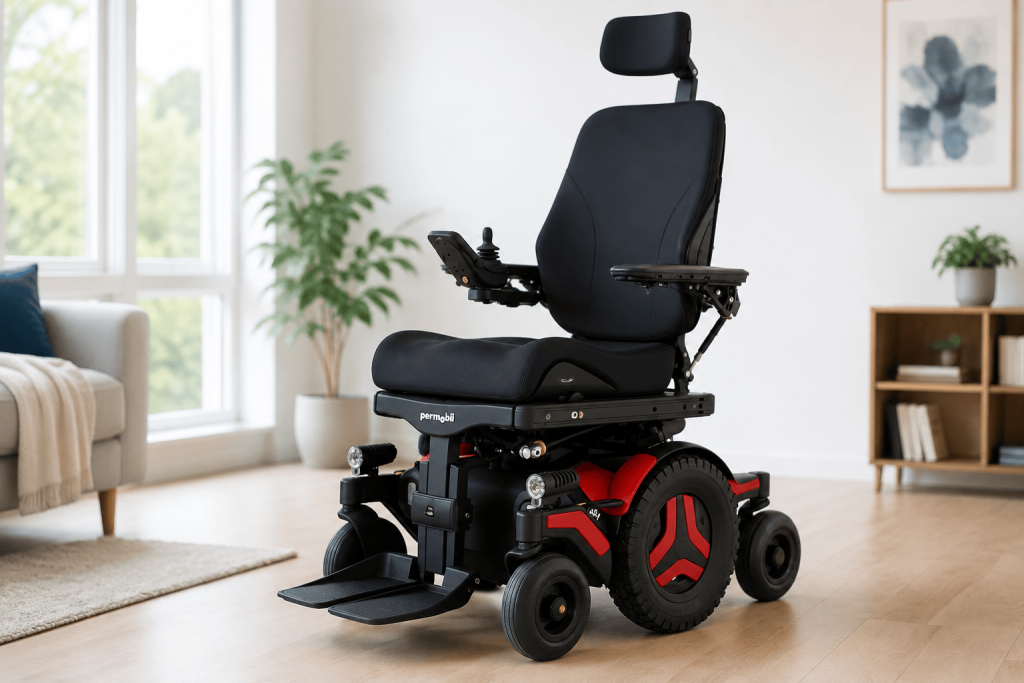
Given the progressive and complex nature of the disease, a standard, off-the-shelf wheelchair will not suffice. The ideal wheelchair for Muscular Dystrophy is a complex rehabilitation device, specifically a highly customizable Group 3 or Group 4 power wheelchair.
(1) Advanced Seating and Positioning (The Core Requirement)
As muscle weakness progresses, the risk of developing spinal deformities like scoliosis and kyphosis, as well as contractures (muscle shortening and tightening), significantly increases. Proper seating is the primary intervention to manage these risks.
(A) Power Tilt and Recline: These power seating functions are non-negotiable for MD management. These power seating functions are non-negotiable for MD management.
| Feature | Key Benefit |
| Power Tilt | Redistributes pressure, reduces strain, and helps manage spasticity and low blood pressure. |
| Power Recline | Opens the hip angle for better pressure relief, comfort, stretching, and rest. |
(B) Custom Contoured Seating: Specialized backrests and cushions provide total contact support, accommodating existing deformities and preventing the progression of spinal curvature. Lateral support is critical to maintaining trunk alignment and resisting leaning caused by unequal muscle deterioration.
(C) Contracture Management: The wheelchair seating system must accommodate fixed joint contractures (common in the hips, knees, and ankles). This may require negative large angles (to tuck legs back) or customized cushions to maintain proper pelvic alignment despite hip limitations.
(2) Alternative Drive Controls and Electronics
As hand and finger dexterity diminish, the ability to operate a standard joystick may be lost. The ideal power wheelchair for Muscular Dystrophy must feature expandable electronics to adapt the control interface.
- Programmable Joysticks: Allow fine-tuning speed, acceleration, and sensitivity.
- Alternative Input Devices: These systems enable independence even with severe weakness:
- Chin Control: A joystick manipulated by the chin.
- Head Array: Sensors embedded in the headrest that respond to subtle head movements.
- Sip-and-Puff: Uses breath control (sipping or puffing into a tube) to steer the chair and operate controls.
- Bluetooth and Integrated Controls: Modern systems, like Quantum’s Q-Logic or Permobil’s controls, allow users to operate their smartphones, tablets, and even smart home devices directly through the wheelchair drive control interface.
(3) Power Seat Elevation and Standing Function
These advanced features boost function, social integration, and physiological health.
- iLevel®/Seat Elevation: Lifts the user up to standing or counter height. This is crucial for reaching objects, engaging in eye-level conversations, and improving independence in tasks like cooking and transferring.
- Standing Wheelchairs: Allow the user to move from a seat to a full standing position. The benefits include improving bone density, promoting better circulation, assisting with bowel and bladder function, reducing the magnitude of contractures, and enhancing social interaction.
(4) Drive Wheel Configuration
The selection of the drive system impacts maneuverability and stability, depending on the user’s primary environment.
- Mid-Wheel Drive (MWD): Most common choice. Offers the smallest turning radius, making it excellent for maneuvering indoors (school, home, office) and is generally intuitive to drive.
- Rear-Wheel Drive (RWD): Most stable at higher speeds and generally better for outdoor travel over varied terrain. Has a larger turning radius.
- Front-Wheel Drive (FWD): Good stability on inclines and obstacles but can be less intuitive for new users.
Why Is a Multidisciplinary Assessment Essential When Choosing a Wheelchair?
Securing the optimal wheelchair is a process that requires a specialized team, often referred to as a Complex Rehabilitation Technology (CRT) team. This team ensures that the chair is medically necessary, clinically appropriate, and perfectly customized.
(1) The Clinical Team: Involves the Physiatrist (PM&R physician) or Neuromuscular Specialist, a Physical Therapist (PT), and an Occupational Therapist (OT), often one who is a Certified Seating and Mobility Specialist (CSMS).
(2) Comprehensive Evaluation: The team assesses the user’s current muscle strength, range of motion (especially for contractures), functional abilities (transfers, ADLs), home and school environment, and, critically, the anticipated progression of the disease.
(3) Feature Matching: This is where the clinical team matches specific power functions (tilt, recline, standing) and controls (joystick, head array) to the user’s documented functional deficits and future needs.
(4) Funding and Advocacy: Since these specialized power wheelchairs and features can be costly, the clinical team and the equipment supplier work together to write extensive medical justifications to secure funding from insurance providers. Users and families often need to be prepared to advocate fiercely for the features that provide the best quality of life.
Conclusion
For individuals living with Muscular Dystrophy, the wheelchair is an indispensable tool that dramatically influences the trajectory of their independence and well-being. By embracing wheeled mobility proactively, particularly by transitioning to a highly adaptable, complex power wheelchair with advanced seating and alternative controls, users can effectively manage energy resources, prevent secondary complications like scoliosis and pressure injuries, and continue to participate fully in life’s activities. The key to success lies in a collaborative, forward-thinking approach, utilizing the expertise of a specialized mobility team to ensure the chair adapts as the disease progresses, providing continuous support and maximum function. A properly chosen wheelchair is truly the power to live fully.
Ready to Find the Mobility Solution That Adapts with You? At Eclipse Mobility, we specialize in Complex Rehabilitation Technology, understanding the critical and progressive needs associated with Muscular Dystrophy. We partner with your clinical team to provide expertly fitted power wheelchairs that feature essential functions like power tilt, recline, and specialized controls designed to support your independence now and into the future.
Secure Your Independence: Find the Right Power Solution.
Frequently Asked Questions
Q.1 When should someone with Muscular Dystrophy start using a wheelchair?
Most specialists say don’t wait for walking to become a real struggle before considering one. Getting a wheelchair into the picture early on saves energy, cuts fatigue, and cuts down fall risk too which, over time, means someone can stay active and independent for much longer.
Q.2 Is a power wheelchair better than a manual wheelchair for Muscular Dystrophy?
Usually, yes. Manual chairs rely on the user pushing themselves, and as Muscular Dystrophy progresses, that becomes harder eventually too hard to keep up. A power wheelchair takes that demand away completely. Strength that would’ve gone into self-propelling gets saved for other daily tasks instead. There’s also the seating side of things: power chairs simply offer options manual ones don’t have room for.
Q.3 What wheelchair features are most important for people with Muscular Dystrophy?
Power tilt and recline are usually considered the biggest ones, since they let position change without needing to physically move the person. Custom seating and pressure-relieving cushions matter just as much though they’re what actually keep pressure injuries at bay and support the body properly as spinal changes or contractures start to develop.
Q.4 Can a wheelchair be customized as Muscular Dystrophyprogresses?
Yes, and this is really where the more advanced power wheelchairs earn their price tag. Expandable controls, alternative driving setups like chin or head controls, seat elevation, standing functions all of it can be added or adjusted so the chair keeps up with the person instead of needing to be swapped out every time something changes.
Q.5 Who helpsdeterminethe right wheelchair for someone with Muscular Dystrophy?
It’s rarely a solo decision. Usually a whole rehab team gets involved a physiatrist or neuromuscular specialist, a physical therapist, an occupational therapist, and someone who specializes in seating and mobility. Together they look at what the person can do now, what’s likely to change, and what their daily environment looks like, then recommend a setup based on all of that.