
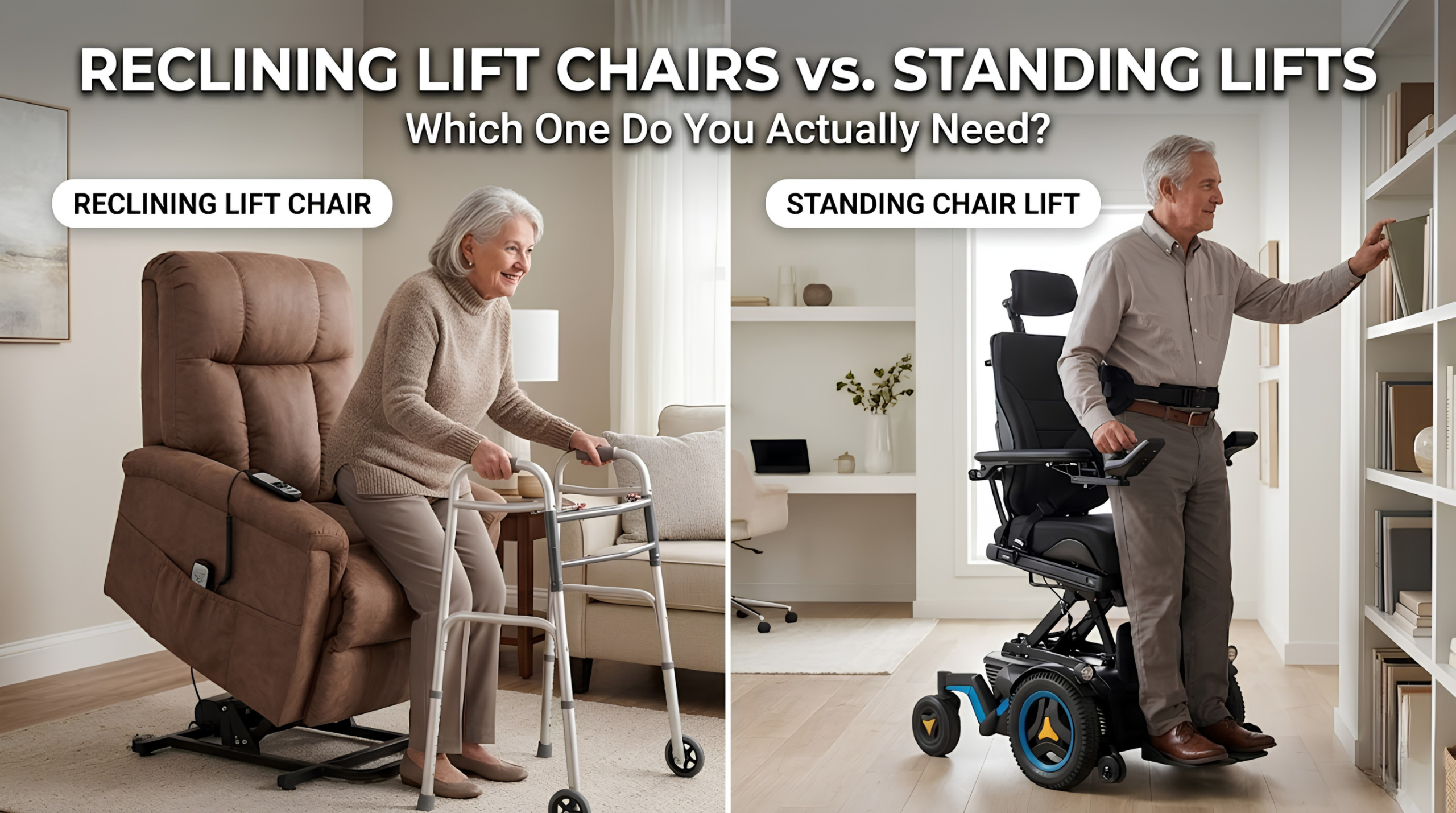
Quick Answer: Reclining lift chairs are motorized recliners that tilt the entire seat forward to help users stand safely, reducing fall risk at home. A standing chair lift (or standing wheelchair) goes further — it lifts users from seated to a full upright standing position for therapeutic and functional benefits. The right choice depends on your mobility goals, diagnosis, and how much standing supports your body’s needs.
What Are Reclining Lift Chairs — and Who Are They Really For?
Most people picture a cozy armchair when they hear “lift chair.” That’s not wrong — but it undersells what these chairs actually do. A reclining lift chair is a power-operated seat that reclinest and tilts forward on a motorized base to assist the user in a standing position. For older adults or anyone with hip, knee, or lower-body weakness, that tilt function is genuinely life-changing.
Here’s the thing we see clients miss all the time: the benefit isn’t just comfort. Reclining lift chairs reduce the strain of sit-to-stand transitions, which is one of the most common triggers for falls in seniors. If your loved one is currently gripping furniture or walls to get up, a quality lift chair directly addresses that risk. At Eclipse Care, we always recommend pairing this with the right,, mobility solution tailored to your lifestyle so the whole home environment becomes safer — not just the chair.
Reclining lift chairs work best for people managing arthritis, Parkinson’s disease, post-surgical recovery, or general age-related deconditioning. They’re a passive assist — the chair does the work, and the user directs it with a simple remote.

What Is a Standing Chair Lift — and How Is It Different?
A standing chair lift — often called a standing wheelchair or power standing system — takes mobility support several steps further than a recliner. Rather than simply angling the seat forward, it transitions the user from sitting all the way to a full upright, weight-bearing position. And in our experience working with clients across a wide range of diagnoses, that distinction matters enormously.
Weight-bearing standing has real, documented benefits: it supports bone density, aids digestion, reduces pressure injuries, and engages the cardiovascular system in ways that sitting simply cannot replicate. One of our go-to recommendations for clients who need standing integrated into their daily routine is the Permobil F5 Corpus VS — a power standing system that provides full vertical lift while keeping the user safe, supported alignment throughout.
For clients living with spinal cord injuries, multiple sclerosis, or muscular dystrophy, a standing chair lift or standing power wheelchair can genuinely change what a day looks like. That’s not a small thing. We also frequently recommend the Quantum Edge 3 and Quantum Edge 4 for clients who need advanced seating and positioning features alongside their mobility needs.
Reclining Lift Chairs vs Standing Chair Lift: Our Honest Take
The simplest way we frame it with clients: reclining lift chairs helpss you get up from a seat. A standing chair lift helps you stay upright throughout the day.
For home use among elderly clients who primarily need sit-to-stand assistance, a reclining lift chair is practical, affordable, and effective. It typically doesn’t require professional fitting or a full clinical assessment to get started.
A standing chair lift — particularly a power standing wheelchair — is a prescription mobility device. It requires evaluation by a licensed ATP (Assistive Technology Professional) or occupational therapist, which is something our team coordinates directly. If you’re navigating, you’re insurance options for a standing device, we can walk you through the clinical justification criteria, so there are no surprises down the line.
For clients who already use a wheelchair full-time, upgrading to a system with standing capability usually makes far more sense than adding a separate lift chair at home. We’ve written more about how custom wheelchairs enhance mobility and independence — it gives a good sense of why individualized fitting matters so much for long-term outcomes.
How We Help You Choose the Right Option
Not every mobility challenge looks the same, and we’ve never believed in one-size-fits-all recommendations. Someone recovering from hip replacement surgery has completely different needs than someone managing progressive ALS or MS.
When you come to us unsure of where your needs fall, we start with a proper evaluation. Our team matchto requirents with the right seating and mobility solution — whether that’s a reclining lift chair for home comfort, a tilt-in-space power wheelchair, or a full standing system. You can explore our services or get started with a consultation whenever you’re ready.
If you’re managing a specific condition, we’ve also put together guides that can help you understand your options in more detail — including resources for people living with multiple sclerosis or ALS.
Find Your Perfect Wheelchair for Comfort & Mobility
Frequently Asked Questions
Q: What is a reclining lift chair?
A: A reclining lift chair is a motorized chair that reclines for rest and tilts forward on a powered base to assist users in transitioning from seated to standing. We commonly recommend it for elderly clients or those with lower limb weaknesses who want to reduce fall risk at home. If you’re wondering whether it’s the right time to explore mobility aids, our guide on when to get a wheelchair can help you think it through.
Q: Does a standing chair lift the same as a standing wheelchair?
A: They’re closely related but not identical. A standing chair lift typically refers to a home-based device that raises the user to a standing position, while a standing wheelchair — like the Permobil F5 — is a full power wheelchair with integrated standing function built for all-day use. The key difference is that a standing wheelchair also supports independent mobility throughout the day.
Q: Does insurance cover reclining lift chairs or standing chair lifts?
A: Coverage varies quite a bit. Reclining lift chairs are often not covered by Medicare unless they meet specific medical criteria. Standing wheelchairs with documented clinical need may qualify under Medicare Group3 for power wheelchair classifications. We help our clients navigate insurance options and prepare the right documentation to support their claim.
Q: Who benefits most from a standing chair lift?
A: Clients with progressive neurological conditions, spinal cord injuries, or long-term mobility limitations tend to benefit most. Regular standing has real physiological value — it’s not just about convenience. We’ve covered this in detail in our post on how power wheelchairs support people with spinal cord injuries, which explains why standing function matters so much in those cases.
Q: Can a tilt-in-space wheelchair replace a reclining lift chair?
A: For some of our clients, yes — especially those who need frequent repositioning for pressure relief throughout the day. A tilt-in-space wheelchair redistributes weight in a different way and is better suited for full-time wheelchair users. A reclining lift chair, on the other hand, is a better fit for someone who is ambulatory but specifically struggles with sit-to-stand transitions.
The right mobility support — whether a reclining lift chair, a standing chair lift, or a customized power wheelchair — should match your actual daily life, not just a diagnosis on paper. If you’d like our help figuring out what fits best, reach out to our team and we’ll start with a personalized assessment.