

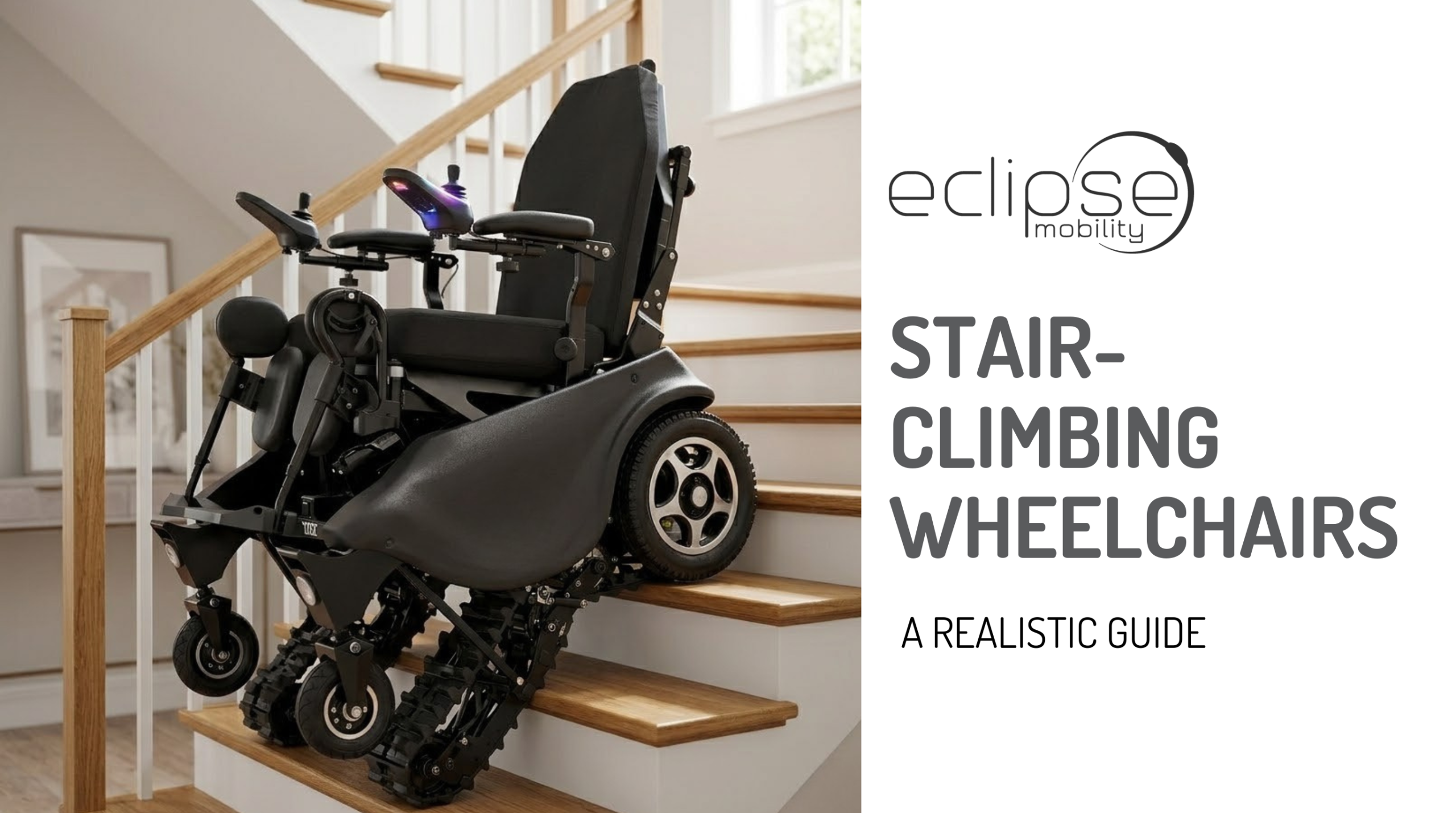
Quick Answer: A motorized stair climbing wheelchair is a power wheelchair built with tracked or multi-wheel systems that let a user go up and down stairs without a ramp or lift. These chairs are niche, expensive, and rarely covered by insurance. For most people, a well-fitted custom power wheelchair paired with home accessibility changes solves the same problem more reliably.
Stairs are the single biggest barrier standing between a wheelchair user and full independence. If you’ve ever watched someone struggle to plan a trip around which buildings have ramped, you already understand why the idea of a wheelchair stair climber sounds like the perfect fix. It promises freedom from that plan — no more calling ahead, no more back entrances.
Here’s the thing most people miss: an electric stair climbing wheelchair and a standard power wheelchair solve overlapping but different problems. One is designed to conquer a specific obstacle. The other is designed to be your everyday mobility system — reliable, insurance-supported, and built around how you actually live. Before you commit to either, it helps to understand what a motorized stair climbing wheelchair actually does, and where it fits next to the power wheelchairs most people end up using day to day.
What Is a Motorized Stair Climbing Wheelchair?
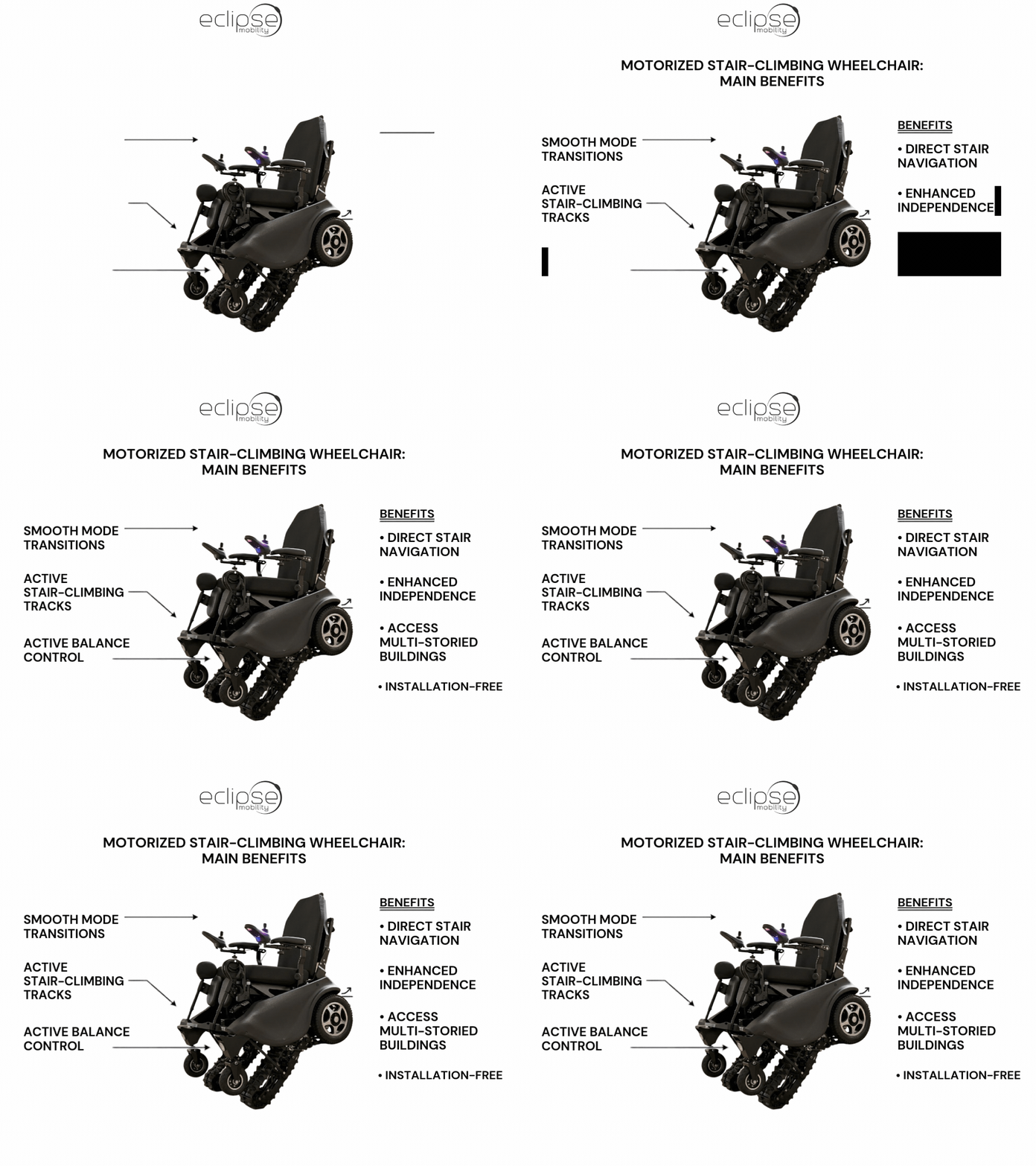
A motorized stair climbing wheelchair is a power wheelchair engineered with a secondary drive system — usually a tracked undercarriage or a rotating multi-wheel cluster — that grips stair edges and moves the chair up or down in a controlled sequence. Models like the Scewo BRO or the Caterwil GTS3 switch between a wheel mode for flat ground and a track mode for stairs, all controlled through a single joystick.
This is a type of complex rehab technology (CRT), the same category that includes tilt-in-space and standing power wheelchairs. What separates it from those systems is purpose: standing wheelchairs address posture and circulation; stair climbers address a single environmental obstacle.
How Does a Wheelchair Stair Climber Work?
The mechanism matters because it explains the cost and limitations. Most electric stair climbing wheelchairs use one of two approaches:
Tracked systems deploy rubber tracks, similar to a small tank. That grip each stair edge as the chair rocks backward and climbs one step at a time. Wheel-cluster systems use three or more small wheels arranged in a rotating triangle around a central axle, walking the chair up the stairs step by step.
Both approaches require a self-balancing gyroscope, a low center of gravity, and precise stair dimensions to work safely. That’s a lot of engineering packed into one chair, and it’s most of the reason these models run well beyond what a standard custom power wheelchair costs.
Who Actually Needs One?
Not everyone with mobility limitations needs a stair-climbing chair, and in most cases, the honest answer is that a well-configured power wheelchair combined with home modifications gets the job done. A motorized stair climbing wheelchair tends to make sense when someone lives in a walk-up building with no elevator option, works in a facility with unavoidable stair access, or simply values the independence of skipping a lift installation entirely.
For everyone else — and that’s the majority of people managing spinal cord injury, multiple sclerosis, muscular dystrophy, or post-stroke mobility loss — the more practical path is pairing the right power chair with ramps, portable stairlifts, or home renovations. Our team walks through those trade-offs during a consultation, because the “cooler” option isn’t automatically the right one for daily life.
 The Insurance Reality
This is where a lot of research online falls short. Electric stair climbing wheelchairs are almost never covered by Medicare, Medicaid, or private insurance in the United States, because they don’t meet the medical necessity criteria under Medicare’s power wheelchair classifications. Standard and complex power wheelchairs, by contrast, frequently qualify — especially when a licensed Assistive Technology Professional documents functional need.
That single fact changes the calculus for most families. A stair-climbing chair might run tens of thousands of dollars out of pocket, while a comparable custom power wheelchair with tilt, recline, or standing function can often move through insurance approval in a matter of weeks.
A Better Starting Point
In most cases, we recommend starting with a proper seating and mobility evaluation rather than shopping for a stair-climbing model first. An Assistive Technology Professional can assess your home layout, your functional goals, and your insurance coverage together, then recommend whether a stair-climbing device is genuinely necessary or whether a well-fitted power wheelchair from providers like Eclipse Mobility covers everything you need. That evaluation alone often saves families months of research and thousands of dollars in trial and error.
Take the Next Step Toward Better Mobility
Frequently Asked Questions
Q: What is a motorized stair climbing wheelchair?
A: It’s a power wheelchair built with tracked or wheel-cluster drive systems that allow it to ascend and descend stairs without a ramp. It functions as both an everyday mobility chair and a stair-navigation device.
Q: Does insurance cover an electric stair climbing wheelchair?
A: Rarely. Medicare, Medicaid, and most private insurers don’t classify stair-climbing chairs as medically necessary, so these devices are usually paid out of pocket. Standard power wheelchairs have a far higher approval rate.
Q: What’s the difference between a wheelchair stair climber and a stairlift?
A: A stairlift is a fixed or portable device installed on the stairs, moving the person (often while seated in their own chair) up and down. A stair-climbing wheelchair is a self-contained chair that climbs stairs directly, with no separate equipment needed.
Q: Is a motorized stair climbing wheelchair right for someone with a spinal cord injury?
A: It depends on trunk stability, home layout, and daily routine. Many people with spinal cord injuries do better with a standard or standing power wheelchair paired with ramps; a stair-climbing model is worth exploring mainly if elevator-free stairs are unavoidable.
Q: How long does it take to get a custom power wheelchair approved?
A: For most clients, the process from consultation to delivery takes about 4 to 6 weeks, depending on the complexity of the customization and how quickly insurance approval comes through.
Have questions about whether a stair-climbing wheelchair or a custom power wheelchair fits your situation? Schedule a consultation with Eclipse Mobility’s Assistive Technology Professionals to get a plan built around your home, your body, and your coverage.